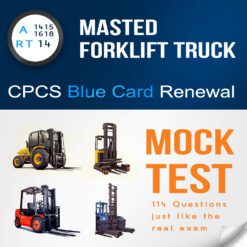
1. What types of masted forklifts are there?
A) Industrial counterbalanced, reach truck, rough terrain, and telescopic handlers.
B) Side loader, reach truck, and telescopic handlers.
C) Industrial counterbalanced, side loader, reach truck, and rough terrain.
D) Reach truck, counterbalanced, and telescopic handlers.
Correct Answer: C) Industrial counterbalanced, side loader, reach truck, and rough terrain.
2. Where can operators find the information regarding a forklift’s safe lifting capacity and height?
A) In the forklift’s user manual or on a capacity chart or decal
B) On the machine’s tire pressure chart
C) In the operator’s lunch break schedule
D) On the forklift’s horn
Correct Answer: A) In the forklift’s user manual or on a capacity chart or decal
3. What happens to the carrying capacity when the center of gravity of a large load exceeds the machine’s load center?
A) The carrying capacity remains unchanged.
B) The carrying capacity increases.
C) The carrying capacity must be increased for better efficiency.
D) The carrying capacity must be reduced.
Correct Answer: D) The carrying capacity must be reduced.
4. What potential exists when lifting or placing a load on a forklift facing downhill on a slope?
A) Enhanced load stability
B) Longitudinal instability and the forklift at risk of tipping forward
C) Improved forklift efficiency
D) Reduced maintenance costs
Correct Answer: B) Longitudinal instability and the forklift at risk of tipping forward
5. What specific steps should be taken before the forklift operator leaves their seat?
A) Apply the handbrake, lower the forks, and turn off the lights
B) Apply the handbrake, put the transmission in reverse, and honk the horn
C) Apply the handbrake, put the transmission in neutral, and switch off the engine
D) Apply the handbrake, engage the forklift’s emergency brakes, and dismount
Correct Answer: C) Apply the handbrake, put the transmission in neutral, and switch off the engine
6. What has happened when operators relied on holding the forklift using the footbrake?
A) Improved operator comfort
B) Enhanced forklift performance
C) Incidents have occurred due to insufficient brake pressure
D) Reduced maintenance costs
Correct Answer: C) Incidents have occurred due to insufficient brake pressure
7. What additional danger is associated with sharp braking while operating a forklift?
A) The possibility of a load sliding from the forks
B) Improved load stability
C) Reduced risk of collision
D) Decreased need for maintenance
Correct Answer: A) The possibility of a load sliding from the forks
8. What factors determine the weight of a load?
A) The load’s color and shape
B) Its size and density
C) The load’s material composition
D) The forklift’s tire pressure
Correct Answer: B) Its size and density
9. What effect does a sideways lean of the forklift have on its stability?
A) The machine becomes less stable
B) It has no effect on stability
C) It improves stability
D) It enhances operator comfort
Correct Answer: A) The machine becomes less stable
10. What should the operator compare with the forklift’s load center?
A) The forklift’s maximum speed
B) The operator’s training schedule
C) The load’s size and shape
D) The load center as indicated in the rated or lift capacity chart
Correct Answer: D) The load center as indicated in the rated or lift capacity chart
11. Why is it important to avoid regularly reaching the maximum lifting capacity for a desired height?
A) To maximize efficiency
B) To demonstrate forklift capabilities
C) To minimize maintenance requirements
D) To ensure safe operation and prevent overloading and instability
Correct Answer: D) To ensure safe operation and prevent overloading and instability
12. What is the recommended spacing for forks in relation to the forklift’s center line?
A) Forks should be of equal width from the forklift’s center line.
B) Forks should be as close together as possible.
C) Forks should be spaced asymmetrically for better balance.
D) Fork spacing does not matter.
Correct Answer: A) Forks should be of equal width from the forklift’s center line.
13. Why is it crucial to ensure that a forklift is on firm level ground when raising a load to height?
A) To increase forklift speed
B) To prevent instability and hazards associated with raised loads
C) To enhance operator comfort
D) To reduce maintenance costs
Correct Answer: B) To prevent instability and hazards associated with raised loads
14. What conditions must be met when a load needs to be placed at height using a forklift?
A) The forklift should be on uneven ground
B) The forklift must be facing the placing point, even on uneven ground
C) The forklift should be traveling at high speeds
D) The forklift must be on firm level ground and facing the placing point
Correct Answer: D) The forklift must be on firm level ground and facing the placing point
15. When a forklift is traveling up a slope with a load, what should be the position of the mast and forks?
A) The mast should be slightly tilted back, and the forks and load kept just clear of the ground but as low as possible
B) The mast and forks should be lowered to the ground
C) The mast and forks should be fully extended
D) The mast should be fully raised
Correct Answer: A) The mast should be slightly tilted back, and the forks and load kept just clear of the ground but as low as possible