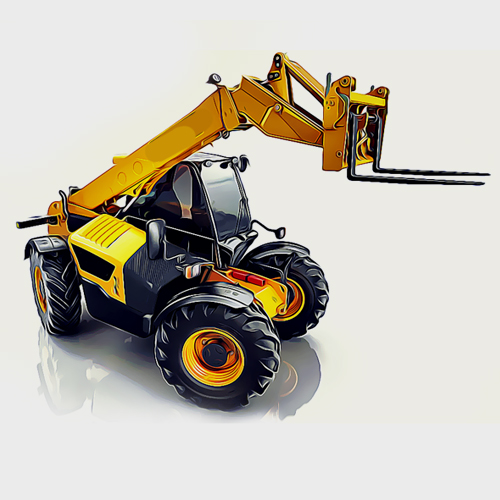
1. What measure is recommended to address the restricted forward vision when traveling with suspended loads?
A) Travel in reverse
B) Travel in a forward direction
C) Travel at higher speeds to complete the task more quickly
D) Travel without any additional assistance
Correct answer: A) Travel in reverse
2. What purpose do front-mounted stabilizers serve in telehandlers with higher lifting capacity and operating reach?
A) To enhance operator comfort
B) To maximize fuel efficiency
C) To provide additional longitudinal stability
D) To improve load visibility
Correct answer: C) To provide additional longitudinal stability
3. What risk is associated with relying solely on the footbrake to hold the telehandler?
A) The operator might become too comfortable
B) Incidents can occur if the operator doesn’t apply enough brake pressure
C) The telehandler may become more stable
D) The telehandler’s speed may increase
Correct answer: B) Incidents can occur if the operator doesn’t apply enough brake pressure
4. How can operators mitigate the risk of load swing and instability?
A) By always traveling and turning quickly
B) By reducing the use of hydraulic functions
C) By following manufacturer’s guidelines
D) By avoiding windy conditions
Correct answer: C) By following manufacturer’s guidelines
5. What is the potential consequence of the boom being too close to an overhead power line?
A) Improved telehandler performance
B) Reduced load capacity
C) Enhanced operator comfort
D) Increased danger of arcing
Correct answer: D) Increased danger of arcing
6. What action must be taken when the center of gravity of a large load exceeds the machine’s load center?
A) Increase the carrying capacity
B) Maintain the load center as is
C) Reduce the carrying capacity
D) Speed up the telehandler
Correct answer: C) Reduce the carrying capacity
7. Why is it important for operators to grasp the conditions that can cause instability in telehandlers?
A) To show off their knowledge
B) To pass the time
C) To enhance machine aesthetics
D) To ensure safety and prevent overturning
Correct answer: D) To ensure safety and prevent overturning
8. When are front-mounted stabilizers typically equipped in telehandlers?
A) In telehandlers with higher lifting capacity and/or operating reach
B) In telehandlers with lower lifting capacity
C) Only in small telehandlers
D) In all telehandlers, regardless of their specifications
Correct answer: A) In telehandlers with higher lifting capacity and/or operating reach
9. What is the typical load center for most telehandlers?
A) 200mm
B) 500mm
C) 800mm
D) 1000mm
Correct answer: B) 500mm
10. How should the forks be spaced to ensure proper load support?
A) With no specific spacing
B) Equivalently, or of equal width, from the telehandler’s center line
C) As far apart as possible
D) As close together as possible
Correct answer: B) Equivalently, or of equal width, from the telehandler’s center line
11. Why is it important for operators to use the correct load chart for the given situation?
A) To demonstrate advanced operating techniques
B) To maximize operator comfort
C) To ensure safe and accurate load handling
D) To make the telehandler more challenging to operate
Correct answer: C) To ensure safe and accurate load handling
12. Why is the operator’s qualification and experience important in assessing a fault?
A) Operators are always qualified to make judgments
B) Experienced operators never encounter faults
C) Operators are not involved in maintenance decisions
D) They can accurately determine the severity of the defect
Correct answer: D) They can accurately determine the severity of the defect
13. Why is good vision essential when placing loads at height?
A) To complete the task more quickly
B) To impress colleagues
C) To ensure accuracy and safety
D) To test the telehandler’s capabilities
Correct answer: C) To ensure accuracy and safety
14. Why is traveling with a raised boom considered hazardous?
A) It greatly increases instability
B) It enhances operator comfort
C) It improves telehandler stability
D) It reduces fuel consumption
Correct answer: A) It greatly increases instability
15. How can the direction of travel on a slope differ depending on whether the telehandler is carrying a load or unladen?
A) The direction remains the same in both cases
B) The telehandler must always travel uphill when carrying a load
C) The operator can choose the direction based on their preference
D) It can vary to optimize stability and safety
Correct answer: D) It can vary to optimize stability and safety
Key words:
telehandler mock test, telescopic handler mock test, A17 RT17 mock test, telehandler CPCS mock test, telescopic handler CPCS mock test, telehandler Citb mock test, telescopic handler Citb mock test, telehandler NOCN mock test, telescopic handler NOCN mock test, telehandler blue card mock test, telescopic handler blue card mock test, telehandler renewal mock test, telescopic handler renewal mock test, telehandler practice test, telescopic handler practice test, telehandler test questions, telescopic handler test questions, telehandler test answers, telescopic handler test answers, telehandler test PDF